Compliance Mapping Now Covers NIST CSF 2.0 and the EU Cyber Resilience Act
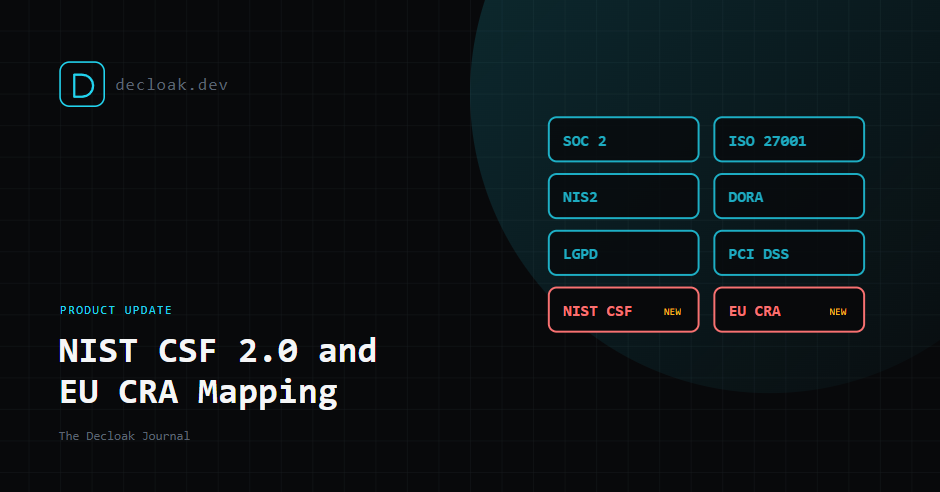
Decloak now maps every finding to eight frameworks: SOC 2, ISO 27001, NIS2, DORA, LGPD, PCI DSS, and now NIST CSF 2.0 and the EU Cyber Resilience Act (CRA).
You don't need to do anything to get them. Each of our 40 finding categories is now also tagged against the NIST and CRA requirement it relates to, so the scans you already run produce NIST and CRA evidence on their own.
Why these two
NIST CSF comes up constantly in US vendor questionnaires, RFPs and board risk conversations, even at companies that aren't formally aligning to it. It was the framework customers asked us for most that we didn't yet map.
The CRA has a deadline that has already passed. Its vulnerability and incident reporting obligations became applicable on 11 September 2026. The rest of the regulation, including SBOM and CE marking requirements, follows in December 2027. Anyone selling software or connected products into the EU is starting to get asked about it.
Put simply, NIST CSF is for questionnaires and the CRA is for EU market access. One scan now covers both.
NIST CSF 2.0: mapped at the level questionnaires ask about
NIST CSF has six high-level functions: Govern, Identify, Protect, Detect, Respond and Recover. Telling a reviewer that a finding relates to "Protect" doesn't help much. Questionnaires cite subcategories, so that is the level we map to.
Some examples:
| Finding | NIST CSF 2.0 subcategory |
|---|---|
| TLS or transport weakness | PR.DS-02: data in transit is protected |
| Missing security header | PR.PS-01: configuration management |
| Vulnerable JavaScript library or server CVE | ID.RA-01: vulnerabilities are identified and recorded |
| Unknown third-party script domain | GV.SC-07: supplier risk is understood and managed |
| Malicious domain | DE.CM-09: monitoring for adverse events |
Most findings land in Protect. Identify, Govern and Detect cover the vulnerability, supply-chain and threat findings.
The CRA: mapped to Annex I of the regulation
The CRA sets its essential requirements in Annex I. Part I covers the security properties of the product. Part II covers how the manufacturer handles vulnerabilities. Here is how our findings map:
| Finding | CRA Annex I requirement |
|---|---|
| Known-vulnerable component | Part I (2)(a): no known exploitable vulnerabilities |
| Configuration and security headers | Part I (2)(b): secure by default configuration |
| Unauthorised access | Part I (2)(d): protection from unauthorised access |
| Transport encryption, exposed sensitive data | Part I (2)(e): confidentiality |
| Script and injection integrity | Part I (2)(f): integrity |
| Tracking pixels | Part I (2)(g): data minimisation |
| Attack surface findings | Part I (2)(j): limiting attack surfaces |
| Third-party component inventory | Part II (1): identifying and documenting components and vulnerabilities |
What a web scan can and can't evidence for the CRA
This is the part we want to be most careful about.
- The CRA is a product regulation, not a control catalogue. It sets requirements for products with digital elements and their manufacturers. Our mapping shows where a scan finding is relevant to those requirements. It isn't a list of boxes you have now ticked.
- Article 14 reporting isn't a scan finding. The 24-hour early warning and 72-hour notification duties for actively exploited vulnerabilities and severe incidents are processes your organisation runs. No scan can evidence them, so nothing maps to them, and we'd rather show that gap than fill it with something misleading.
- A web scan is supporting evidence, not a conformity assessment. It tells you about the security of what is deployed and reachable. A product's CRA posture covers far more, from secure development to updates and documentation.
- Every mapping is indicative. The same disclaimer applies as for every other framework: this is not a certified audit.
Used that way, it is still useful. A scan that shows no known-vulnerable components, secure defaults and encrypted transport is exactly the kind of evidence a CRA file, or a customer asking about one, can draw on.
Where you'll see it
- Compliance badges on each finding, and the report's compliance view, now with eight framework tabs
- Framework readiness scoring, and the compliance tiles on your account and domain scoreboards, now with eight bars
- The compliance tab in the dashboard, and the CSV control export
- The PDF compliance appendix on Pro and above, plus the framework summaries on the Active Testing, AI Pentesting and agent reports
- The in-app assistant, which can now look up NIST and CRA mappings for you
Getting it
Compliance mapping is part of Pro and above. If you're already on one of those plans, your existing and future scans now show NIST CSF and CRA evidence with nothing to switch on.
New to compliance mapping? Our guide on turning security findings into audit evidence explains how it works and what it is for.
One scan, eight frameworks. See Decloak's compliance features →