Uncloaked: AI Code Security Has Barely Moved in a Year, and Veracode Has the Numbers
Every few weeks a new model launches with better benchmarks, longer context and stronger reasoning. Veracode's latest report puts a number on one thing that hasn't improved, and the number hasn't moved.
The headline
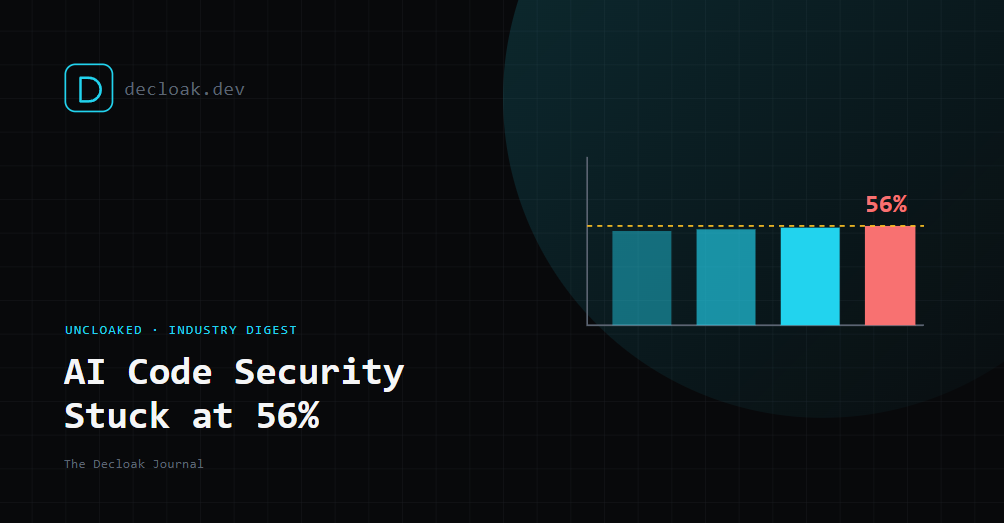
Veracode published its 2026 GenAI Code Security Report on 28 July. Across four testing snapshots and more than 100 models, the average security pass rate is 56%. Press coverage of the report puts the starting point at 55%, so that is one percentage point of progress. Veracode's own description is that the result is "virtually unchanged since last year's report".
This edition tested 11 new models across 80 coding tasks, under standardised conditions and with no security-specific prompting. The contrast is what makes it striking. Models now produce code that compiles about 100% of the time. On security, they fail nearly 44% of the time, introducing a vulnerability from the OWASP Top 10.
Veracode's co-founder Chris Wysopal put it plainly: models "may be almost syntactically perfect, but they are still failing on nearly half of all tasks where security is needed."
The volume problem
A flat failure rate would be tolerable if the amount of AI code were flat too. It isn't. Coverage of the report notes that AI now writes roughly half of all committed code. The failure rate held steady while the volume underneath it grew. The result is more vulnerable code shipping, even though each individual model looks no worse than before.
Three assumptions the data doesn't support
The report takes apart a few comfortable beliefs.
"Coding-specific models are safer." They aren't. Models built for code averaged a 51% pass rate, against 52% for general-purpose models. Choosing a coding-focused tool on the assumption it minimises security risk gets you the same rate as everyone else.
"Bigger models are safer." Model size made no meaningful difference. Large models (over 100 billion parameters) averaged 53%, medium models 51% and small models 51%.
"The best model has this solved." The top model in this round, GPT-5.5, scored 68%. That still means it fails nearly one security task in three. Six of the 11 models sat between 50% and 53%, and the lowest scored 50%, which is a vulnerability in every other output.
There was one factor that helped. Reasoning models kept a consistent edge over non-reasoning ones, at 56% versus 51%. Veracode suggests extended reasoning works as a kind of internal code review. It is an edge, not a fix.
By language, Python scored best at 63% and Java worst at 30%. Java was the only language with a clear upward trend over the past year, which is a small piece of good news attached to a bad absolute number.
Where the holes actually are
The pass rate averages very different results. According to TNW's coverage of the report, models handled SQL injection and weak cryptography reasonably well, at 83% and 87%. On cross-site scripting they managed 15%, and on log injection 12%.
Those aren't edge cases. XSS is one of the most common web vulnerabilities there is, and the models barely register it. The likely reason is that SQL injection has a clean, well-known fix (parameterised queries), while XSS depends on context: where a value ends up, how it is encoded and which framework is rendering it. That context is exactly what a model can't see when it writes one function in isolation.
What the report doesn't prove
It is worth being careful here, because the number is easy to misread.
- The tests ran against raw models. There were no agents, guardrails or human review in the loop. In a real pipeline those add a layer of defence. So 56% is the rate at which models generate flaws, not the rate at which they reach production.
- A benchmark is not your codebase. 80 standardised tasks tell you about tendencies, not about any particular app.
- "One point" is an average over a changing field. Different models were tested at different times, so it is a trend line, not a controlled before-and-after on one model.
None of that rescues the headline. It just means the honest reading is "models don't reliably write secure code by default", not "56% of your app is vulnerable".
What to do with it
Veracode's advice is to treat AI-generated code like any unreviewed code: scan it, fix it, and never ship it blind. We agree, and would add a few specifics.
- Assume the default is insecure and design for review. If a model wrote it, someone or something should check it before it deploys.
- Watch XSS and output handling in particular. If the models fail there most, that is where your review time pays back most.
- Add checks that run on what you actually ship. Source-level tools read code. What reaches users is the deployed result: the headers, the JavaScript bundle, the database rules, the exposed endpoints.
- Re-check after every AI-assisted change. A prompt that "just tweaks the settings page" can also change a policy, a key or a route.
The thread connecting it all
We covered a related pattern in our earlier digest on 380,000 exposed apps and the vibe-coding security problem. Veracode's report is the model-side view of the same story: fast generation, no built-in security instinct, and a gap that only shows up once the site is live.
To be clear about where Decloak fits, we don't read your source code. We scan the deployed site from the outside, the way an attacker would, and check the things AI-built apps most often get wrong: missing headers, exposed keys, open database rules, vulnerable libraries and exposed endpoints. On Enterprise, AI Pentesting goes further and tries to confirm XSS and SQL injection in a sandbox, so a finding comes with proof rather than a guess.
Given a 15% pass rate on XSS in the generated code, whether a reflected input on your site is actually exploitable is a question worth answering before someone else does.
Sources: Veracode's press release on the 2026 GenAI Code Security Report · Veracode's report page · TNW's coverage, including the vulnerability-type breakdown
Decloak checks what your AI-built app actually ships, alongside seven other attack surfaces, in a free 15-second scan. Scan your site free →