Your Security Grade Might Have Been Grading a Firewall's Challenge Page. Decloak Now Knows the Difference
Most websites now sit behind a CDN or a web application firewall (WAF): a service in front of the server that filters and caches traffic. Many of these challenge or block automated visitors, and security scanners are automated visitors.
Until now, Decloak couldn't always tell when that happened. If a firewall served us a "Just a moment..." challenge or a 403 block page, we graded that page's headers and scripts as if they were your site. On a public free report, that meant a grade describing the firewall's challenge page, not the website behind it.
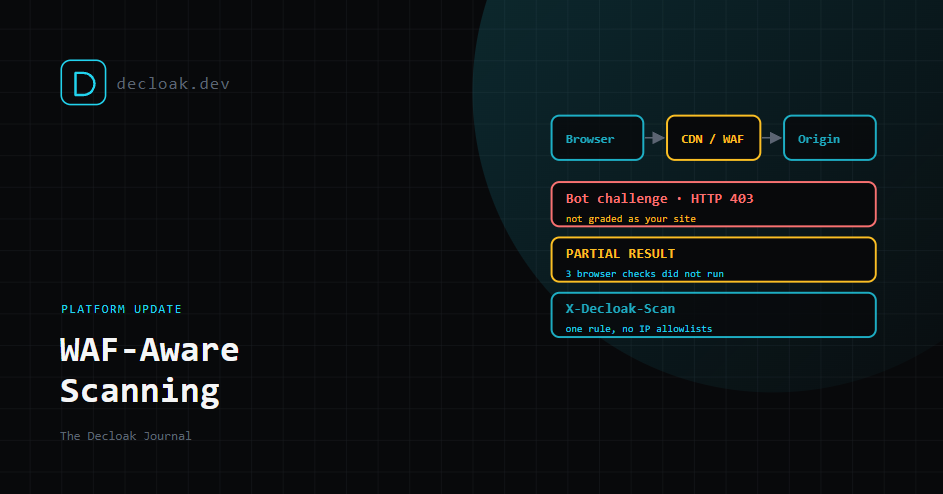
That's now fixed. Decloak recognises when a firewall, CDN or bot-protection service blocks or challenges it, and refuses to grade the block page. Every report also shows what sits between visitors and your server, and each relevant finding says where it was observed, so you know which layer to fix.
What was going wrong
Wrong grades. A challenge page has its own headers and scripts. Grading them told you about the firewall, not about you.
Misleading findings. Bot-protection scripts on a challenge page showed up as unknown third-party domains on your site. In one test, 12 of a site's 40 findings came from the challenge page.
No idea where to fix things. A missing security header might be your web server's fault, or it might be stripped or never added at the CDN. Reports didn't say which, so teams often fixed the wrong layer.
"Which IPs do I allowlist?" Customers whose firewall blocked us asked for our scanner IP addresses. We don't use fixed IPs, so there was no good answer.
How it works
Every scan already fetches each page twice: once as a direct request, for headers, TLS and HTML, and once in a real browser, for scripts, network traffic and third parties. Decloak now compares the two responses and checks each for the signature of a known firewall block, challenge or rate limit.
Those signatures are vendor-specific. An ordinary 403 from your own application is never mistaken for a firewall, and is still treated as your site's real response.
| Direct request | Real browser | What happens |
|---|---|---|
| Real page | Real page | Normal scan and grade |
| Blocked | Real page | Headers and HTML are graded from what the browser received. The grade stands. |
| Real page | Challenged | Browser-only checks (network traffic, third parties, injected scripts) are dropped rather than graded on the challenge page. The result is marked Partial. |
| Blocked | Blocked | No grade. The report names the firewall that blocked us and shows how to let the scanner through. |
Some JavaScript challenges solve themselves in a real browser after a few seconds. We give them up to 12 seconds before judging anything.
On multi-page paid scans, blocked pages are left out of the grade. If blocks make up half or more of the pages the crawl has visited, with at least five visited, the crawl stops early rather than wasting time on block pages.
Which services we recognise
Block and challenge pages are recognised for Cloudflare, Vercel, AWS WAF, Akamai, Imperva (Incapsula), Sucuri, DataDome, HUMAN (PerimeterX) and Wordfence, plus rate limiting (HTTP 429) from anyone.
Separately, reports identify 15 CDN, hosting and firewall providers in front of a site, including Fastly, Netlify, Azure Front Door, Google Cloud and Bunny CDN. A provider can be identified without being one we recognise block pages for.
That's a specific list, not "every firewall". If a service we don't recognise blocks us, tell us, and we'll look at adding its signature.
What you'll see in reports
These changes appear on free and paid reports, on the live progress page for paid scans, and in PDF exports in all 11 supported languages.
An Infrastructure section
A simple chain shows what sits between a visitor and your server: Browser, then CDN or WAF, then origin server, naming each provider we detected. It also shows the page's edge cache status (hit or miss) and whether the scan was complete or partial.
An "Observed" tag on findings
Header, cache and script findings now say where they were seen:
| Tag | What it tells you |
|---|---|
| Set by the CDN | The CDN added this, so the fix belongs in the CDN's settings |
| Observed at the CDN edge | Seen in the response from the CDN, which may have changed it |
| At the origin server | Coming from your own server or application |
| Only in the browser | Only appeared when a real browser loaded the page |
Each tag explains what it means for the fix. For header findings behind a known CDN, it also points to where that CDN's response-header rules live. Fixing a missing header in your application does nothing if the CDN strips it on the way out, and this is how you find out.
A Partial result banner
When part of a scan was blocked, a banner names the firewall and lists exactly which checks didn't run. A clean result and an unchecked result should never look the same, especially when the report is used as audit evidence.
A "We couldn't scan this site" page
When everything was blocked, there's no grade. You get the reason, the evidence (for example, "Bot challenge · HTTP 403") and the steps to let the scanner through. This builds on the change we made in September, when unreachable sites stopped getting an A.
Four new checks
Understanding the layers in front of a site made four new checks possible:
- Cached responses that set cookies. A session cookie served from a shared cache can leak from one visitor to another.
- Logged-in pages without a private or no-store cache rule. Pages meant for one person shouldn't be cacheable for everyone.
- Security headers that differ between a browser and a direct request. A sign that a CDN rule or bot-detection logic is changing responses, so what you tested may not be what visitors get.
- Possible origin exposure (paid scans). Subdomains such as
origin.ordirect.that resolve outside the CDN's published address ranges. If your origin server answers directly, an attacker can skip the firewall entirely. The last one is a hint to investigate, not proof. It uses Cloudflare's and Fastly's published IP ranges and origin-style subdomain names. It's also entirely passive: we flag it, but we never send traffic to the possible origin to test it. Our post on forgotten staging subdomains covers why these leftovers matter.
The allowlist header
Every paid team, on Starter, Pro and Enterprise, now has a private value under Account, then Team. Every scan the team runs sends it in an X-Decloak-Scan header. Your firewall then needs one rule: skip protection when this header has this value.
- It only goes to your own site. It's never sent to third-party scripts, analytics or CDNs the page loads, and it's re-checked at every redirect, so it can't follow a redirect to someone else's site.
- Owners and admins control it. They can copy or regenerate it. Viewers can't see it. Regenerating it is recorded in the team's activity log.
- There's setup guidance for common services. Step-by-step instructions for Cloudflare, AWS WAF and CloudFront, Akamai, Imperva, Vercel, Sucuri and Wordfence are on the Team page and on any blocked or partial report. Vendor dashboards change, so if a step doesn't match what you see, follow the vendor's own documentation for header-based rules and let us know.
- It covers everything. The full-site scan, Active Testing and AI Pentesting all send it. Building this also closed a gap where custom headers set in an Expert Mode scan profile could follow a redirect to another site. They're now checked the same way.
What we chose not to do
No fixed scanner IPs. Publishing IPs for you to allowlist would mean anyone scanning from those addresses gets past your firewall, including another Decloak customer scanning a site they don't own. A per-team secret header is narrower. It only works for your team's scans, and you can rotate it in one click.
No firewall bypass attempts. Decloak doesn't try to get around protection. You let us through, or we tell you we were blocked. We considered actively testing whether your origin server answers when the CDN is skipped, and decided against it: it means sending traffic to infrastructure you may not realise is in scope. We flag the possibility and let you decide.
No guessing. Block detection only fires on a recognised vendor signature. A plain 403 from your own site is still your site's real response, and is graded as such.
Tested on real sites
Before release, we tested on live sites:
- A large software-review site behind a major CDN challenged both our requests. It now gets no grade, instead of a grade for the challenge page.
- A large property site behind a bot-protection service challenged our browser. It was graded as Partial, and 12 findings that came from the challenge page were dropped.
- A regression check on five well-known sites showed grades unchanged where nothing was blocked.
The honest limits
- Recognition is vendor-specific. Services not listed above may not be detected yet.
- Partial means partial. We can't tell you what a check that didn't run would have found. The allowlist header gets you a complete scan.
- The header only works if you add the rule. We send it on every scan, but your firewall decides what to do with it.
Try it
Paste a URL into the free scan, open the full report and look for the Infrastructure section. If you're on a paid plan and your firewall has been blocking us, your allowlist value is waiting under Account, then Team.
Find out what sits between your visitors and your server. Run a free scan →